What we're looking at when a panel's done
Most calls come in because a panel is visibly failing — a rip that's spreading, a corner that's pulled loose from the track, or screening that's sagged and gone loose in the frame. Sometimes it's less dramatic: mesh that's gone brittle and thin, or a panel that's noticeably more see-through than the ones next to it.
On a lanai or pool cage, one bad panel usually isn't the only one worth checking. Panels installed at the same time have seen the same sun and the same wind, so if one's failing, its neighbors are on the same clock. Sun and steady wind load do the real wear on these panels over the years — an occasional light winter freeze here isn't what takes a panel out.
Getting up to the panel without damaging the frame
Enclosure frames aren't rated to hold a person's weight, so we don't climb them. We measure and work each panel from walkboards or a ladder set up alongside the enclosure, which keeps pressure off the aluminum while we're taking measurements and fitting new screening into place. It's a slower way to work than just stepping up onto the frame, but it's the difference between a clean repair and bending a rail that then needs its own fix.
We measure the panel opening directly rather than going off a rough estimate, since even a small miscut in a panel this size means the screen won't seat right in the track and will work itself loose again within a season.
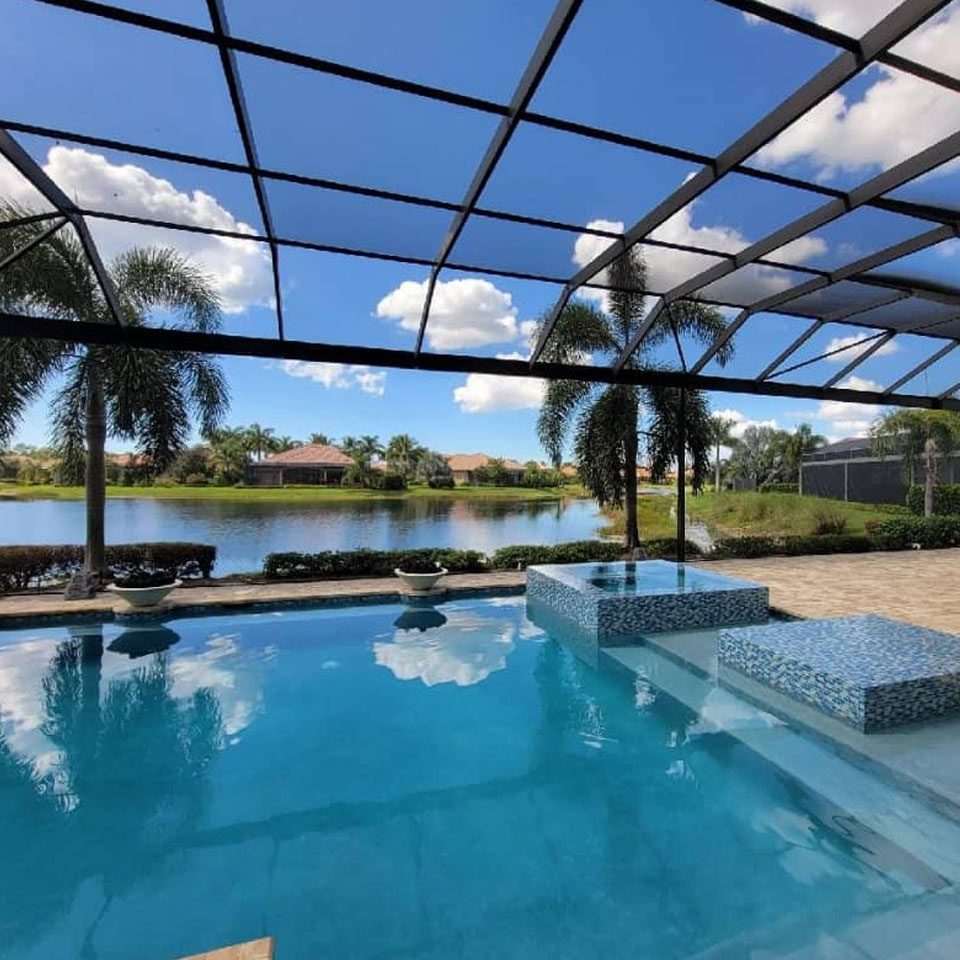
Picking the right mesh for the panel
Not every panel gets the same screen. We carry standard insect mesh, solar screening, pet mesh, No-See-Um mesh, and a heavier-duty option, and which one goes into a given panel depends on what that panel has to deal with — sun exposure, whether pets are around that side of the enclosure, or what's biting on a still evening. A panel that takes hard afternoon sun all year is a different call than one that's shaded most of the day.
We'll walk the enclosure with you and talk through which panels are candidates for a different mesh versus a straight like-for-like replacement. Sometimes it's worth switching, sometimes the original mesh was the right call and just needs replacing in kind.
Cutting and fitting the new screen
Once the old mesh is stripped out of the panel track, the job comes down to a utility knife and a flathead screwdriver — the screwdriver works the screening into the track groove, the knife trims the excess clean along the edge once it's seated. It's hand work, and rushing it shows up immediately as a wave or a loose spot in the finished panel.
The trim has to run tight along the track without nicking the aluminum, since a scored track edge gives the next screen a rough spot to start tearing against.
What it costs and what changes the number
Basic screened-enclosure rescreening runs $1 to $2 per square foot, so the cost on a given panel comes down mostly to its size — a small panel next to a doorway is a quick, inexpensive fix, while a tall panel spanning a full section of the cage costs more simply because there's more screen to cut and fit. Mesh type factors in too; heavier or specialty screening isn't the same material cost as standard insect mesh.
If we're already out for one panel, it's worth having us look over the rest of the enclosure while we're there — quoting a few panels at once usually beats calling back separately for each one as it fails.
The Facts Behind the Number
- Free Estimates
- You pay for work, never for the quote.
- We answer the phone ourselves
- When you call, someone who knows your job answers.
What the Work Involves
A visual look at what the service involves.

How It Works
-
Reach Out
A two-minute call is enough to tell us what we're working with and what to check first.
-
Free Inspection
We come out, measure what's actually happening, and walk you through what we find.
-
Clear, Written Quote
We put the fix, the timeline, and the number on paper — take your time with it.
-
Job Done, Checked, Cleaned Up
We complete the repair, verify it solved the problem, and stand behind the work.
Some of what that looks like in the field:
- The technician measures the spline diameter and frame channel before selecting replacement spline.
- The technician lays replacement mesh over the frame with approximately one-half inch of overlap on each side.
Related Services
- Window Screen Rescreening
- Screen Door Rescreening
- Custom Window Screen Fabrication
- Window Screen Frame Rebuilding
- Screen Door Roller Replacement
- Screen Door Parts And Kickplate Replacement
- Pet Resistant Mesh Installation
Serving Jupiter and Nearby
Serving Jupiter, FL. Call (561) 941-9695 to confirm coverage for your address.
Straight Answers
Get a free quote today — call (561) 941-9695.